broadcast
Sme-cam
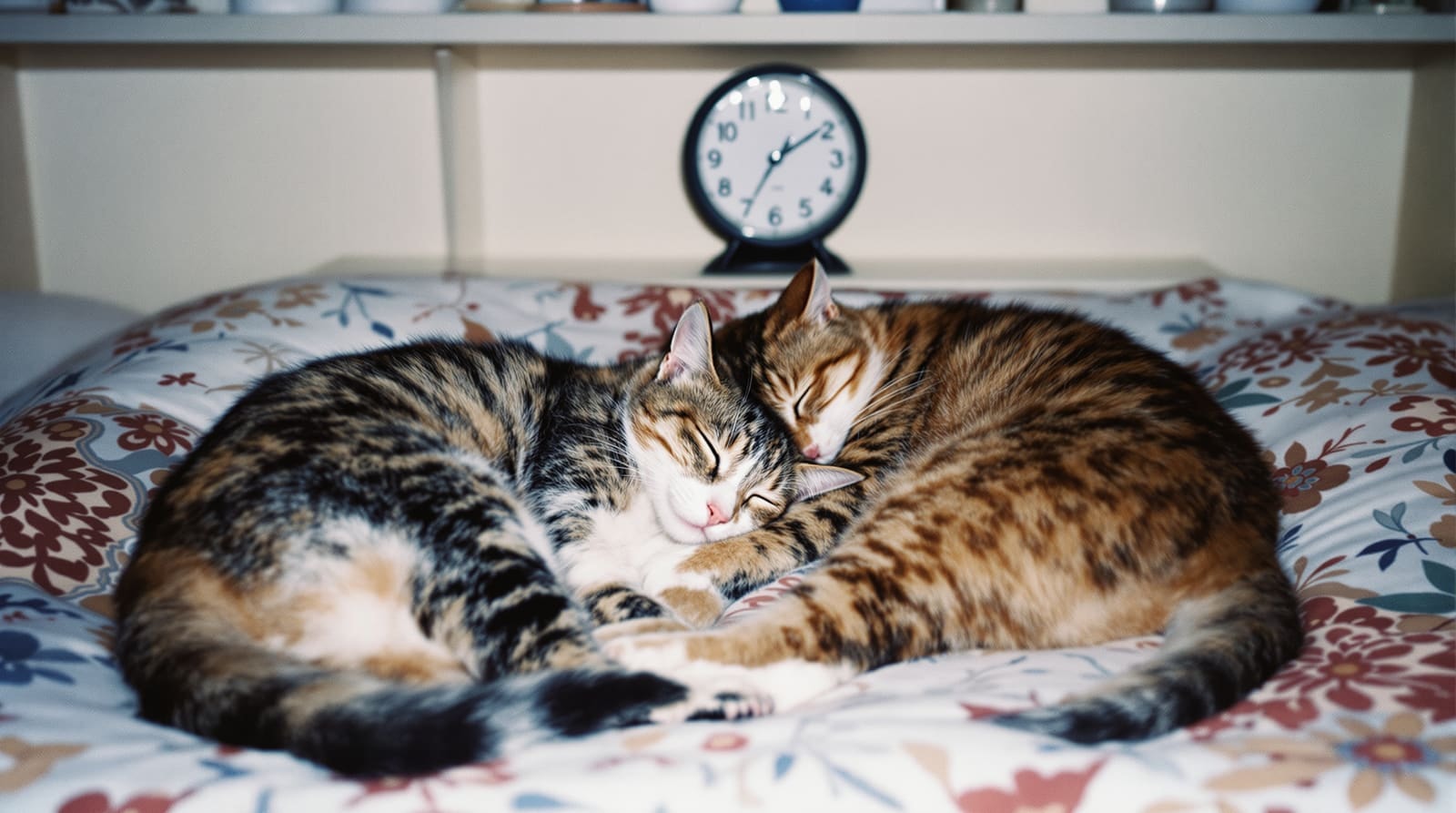
Live webcam. Twenty-four hours a day, seven days a week.
Sme-cam broadcast continuously from a first-floor apartment for a little over four years. The subjects were two cats, Cheese and Sme, and a clock. Nothing else was in shot and nothing else was ever intended to be.
Technical specifications
- Refresh interval: continuous.
- Field of view: one quilt, two cats, one clock. Fixed. The camera was never moved, on principle, and was in any case taped down.
- Uptime: 100%, excluding the outage described below.
- Lighting: ambient, supplemented at night by the clock.
- Audio: none, by request of the subjects.
A note on the correspondence
Over the years a number of viewers wrote in to report that the Sme-cam image appeared to be frozen. Some were quite insistent. Several noted that the clock had not moved, that the cats had not moved, and that in one case a fold in the quilt had remained in exactly the same position across a period of eleven months.
We investigated each of these reports and found no fault.
The cats were asleep. Cats sleep for between twelve and sixteen hours a day and these two were at the upper end of that range and had been for some time. The clock had stopped, which is a fault in the clock and not in the broadcast, and replacing it would have altered the field of view, which as established was fixed. The fold in the quilt is a matter for the quilt.
Viewers who continued to press the point were referred to the fine print.
The outage
Sme-cam went dark for six days in the autumn of its third year. We apologise unreservedly for the interruption and can confirm that the cause has been identified and addressed.
The cause was that one of the cats had moved, and we were waiting.
Thumbnails
A secondary page carried a contact sheet of around twenty further photographs of Cheese and Sme — on the futon, on a headboard, on a quilt, in a patch of sun, at Christmas, and on six separate occasions in a cardboard box that had contained something else. Those images are unavailable. The contact sheet, in its day, took nine minutes to load and people waited.
Why almost none of this survives
A short honest note. The webcam page is the single most fragile kind of page there is, and there were tens of thousands of them.
A webcam page is, by construction, a small piece of HTML pointing at an image file that is supposed to be different every time you look. Archive it and you capture the frame that happened to be there, which is the one thing the page was never about. Archive it twice and you get two unrelated pictures and no way to know how many were in between. And the moment the machine in the spare room is unplugged, everything the page ever was becomes a broken image icon — because unlike an article, a webcam page has no content of its own to fall back on.
That is the whole reason the era of personal webcams, which lasted the better part of a decade and involved an enormous number of people, is almost entirely absent from the record. What survives is the furniture around it: the captions, the apologies for outages, the pages explaining how to view it. The Library of Congress web archiving program sets out plainly why the dynamic parts of a site are so much harder to keep than the static ones.
Sme-cam is the exception, in that a broadcast which never changed is the only kind that archives perfectly. That was a design decision.
Editors' note
Sme-cam is off. It has been off for a very long time. Cheese and Sme were cats belonging to the household this publication was made in, and they are the only residents of it we are prepared to identify.
Elsewhere: the found slides, the comics, the fine print. Back to the front page.