comics
Terrible Tales
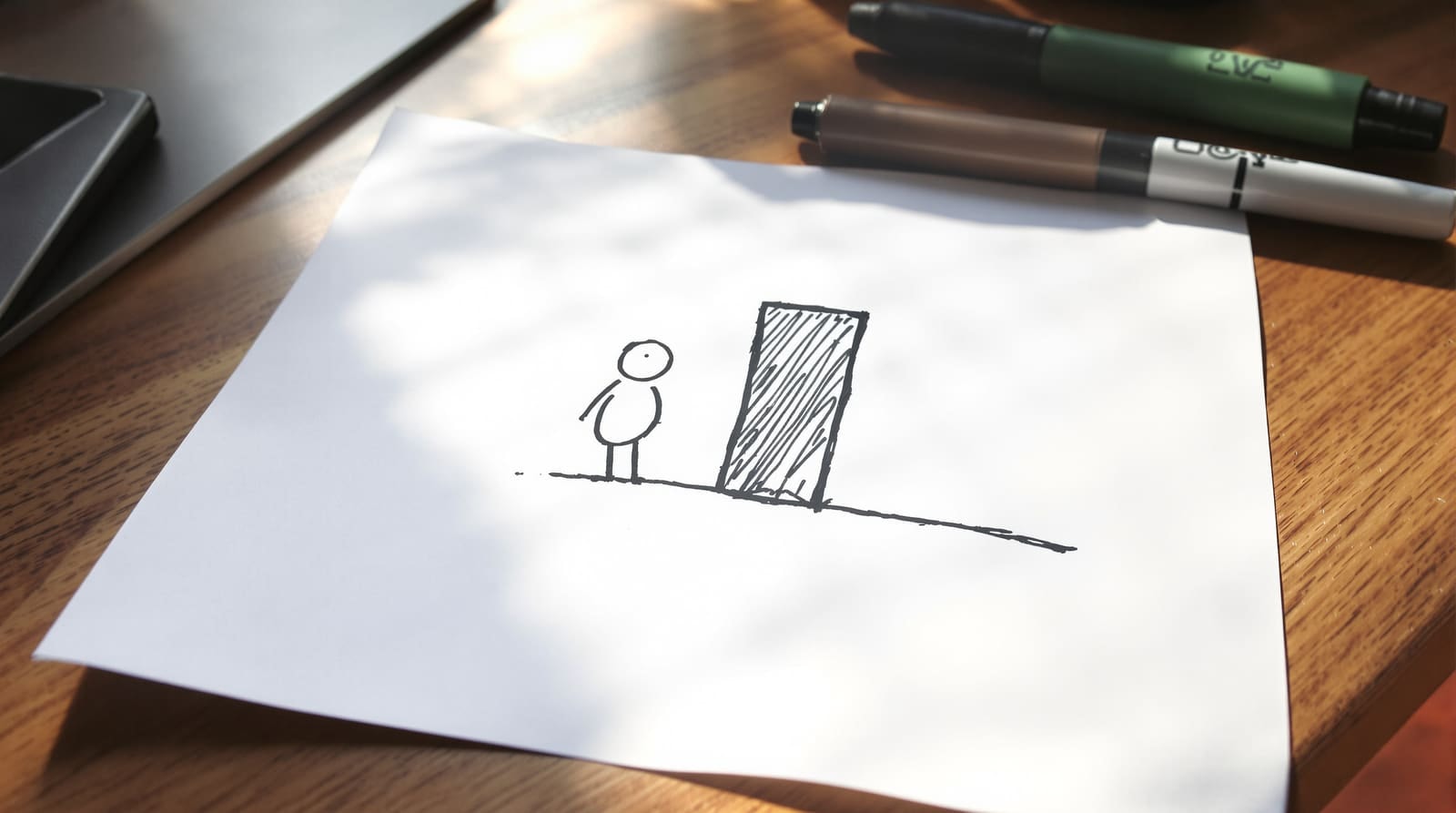
The instruction was:
CLICK ON A PICTURE TO SEE A TERRIBLE TALE
There were three pictures. Each one led into a run of single-panel strips, drawn in marker on ordinary paper, scanned on a flatbed at the wrong setting, and posted one at a time over a period of years. Between them they ran to somewhere over forty panels.
The panels themselves are unavailable. What follows is the shape of the three runs: their characters, premises and order.
The first run
Seventeen panels. A figure attempts a small ordinary task — posting a letter, returning a coat, waiting for a lift — and the task goes wrong in a way that is entirely his own fault and entirely unavoidable. There is no dialogue in the first eleven. The comedy is in the drawing, which is bad, and in the timing, which is not.
The final panel of this run was widely disliked and we stand by it.
The second run
Thirteen panels, and the only one of the three with a recurring second figure. Two people who plainly do not like each other are obliged to complete something together. Each panel is a single moment from a different day. Nothing is ever resolved and neither of them ever says so.
This run is the one readers wrote in about. It was drawn considerably better than the other two, which we always felt was a mistake.
The third run
Fifteen panels. A steady, patient figure doing a job that does not need doing, week after week, with total commitment. There is no joke in most of these. There was not meant to be. It ran for eighteen months and stopped without an ending, which several people took to be the ending.
On single-panel comics
A short serious note, since the form is more demanding than it looks.
A single panel has to do in one image what a strip does in three or four: establish a situation, imply everything that led to it, and land the turn — all simultaneously, because the reader takes it in at once rather than in sequence. There is no build. There is no beat before the punchline. Everything has to be true in the same instant, which is why the good ones are so often about a person caught in the middle of something rather than at the end of it.
It is also, historically, the form that amateurs reach for first, because it needs one sheet of paper and no plan — which is precisely how three quarters of the web comics of the early 2000s began, this one included. The proper history of the form, from newspaper panels through to the underground and small-press traditions that the web scene inherited without knowing it, is held at the Billy Ireland Cartoon Library & Museum, which is the largest collection of its kind anywhere and is open to anyone who asks.
Editors' note
The section included recurring characters, captions and a defined running order.
What is here is a record that they existed, which is not nothing.
Elsewhere: the Found Slide Foundation, Ask Eight-Ball Willis, Sme-cam and further reading. Back to the front page.